SCIENCE BLOG - Paper: Dust destruction signals shock-accelerated outflows in the nearby active galaxy NGC 1068
Luke Holden - 17th July 2026
While I was travelling for conferences in mainland Europe over the past few weeks, my latest first-author paper was accepted for publication in MNRAS, and can be accessed here. This is particularly exciting for me, since this is based on Very Large Telescope observations that I proposed as principal investigator.
We investigated the physical mechanisms at play in the inner regions of the nearby active galaxy NGC 1068: despite being one of (if not the) most well-studied AGN, the way it accelerates gas outflows (see the schematic on my research page) is strongly debated. The combination of our detailed observations and Bayesian emission-line fitting method allowed us to separate the emission arising from the outflowing gas and non-outflowing gas in this object for the first time. Subsequently, applying a range of diagnostics to this separated emission revealed that the outflowing gas is significantly denser than the non-outflowing gas, and that it contains a negligble amount of dust. This implies that the outflow driving mechanism both compresses the gas and destroys its dust grains during acceleration, a scenario which is readily consistent with AGN-induced shocks. In this way, our study provides direct evidence for shocks being the driving mechanism of an AGN-driven outflow, and demonstrates that AGN can have a direct impact on the inner regions of their host galaxies by destroying dust grains (which are thought to play an important role in star formation).
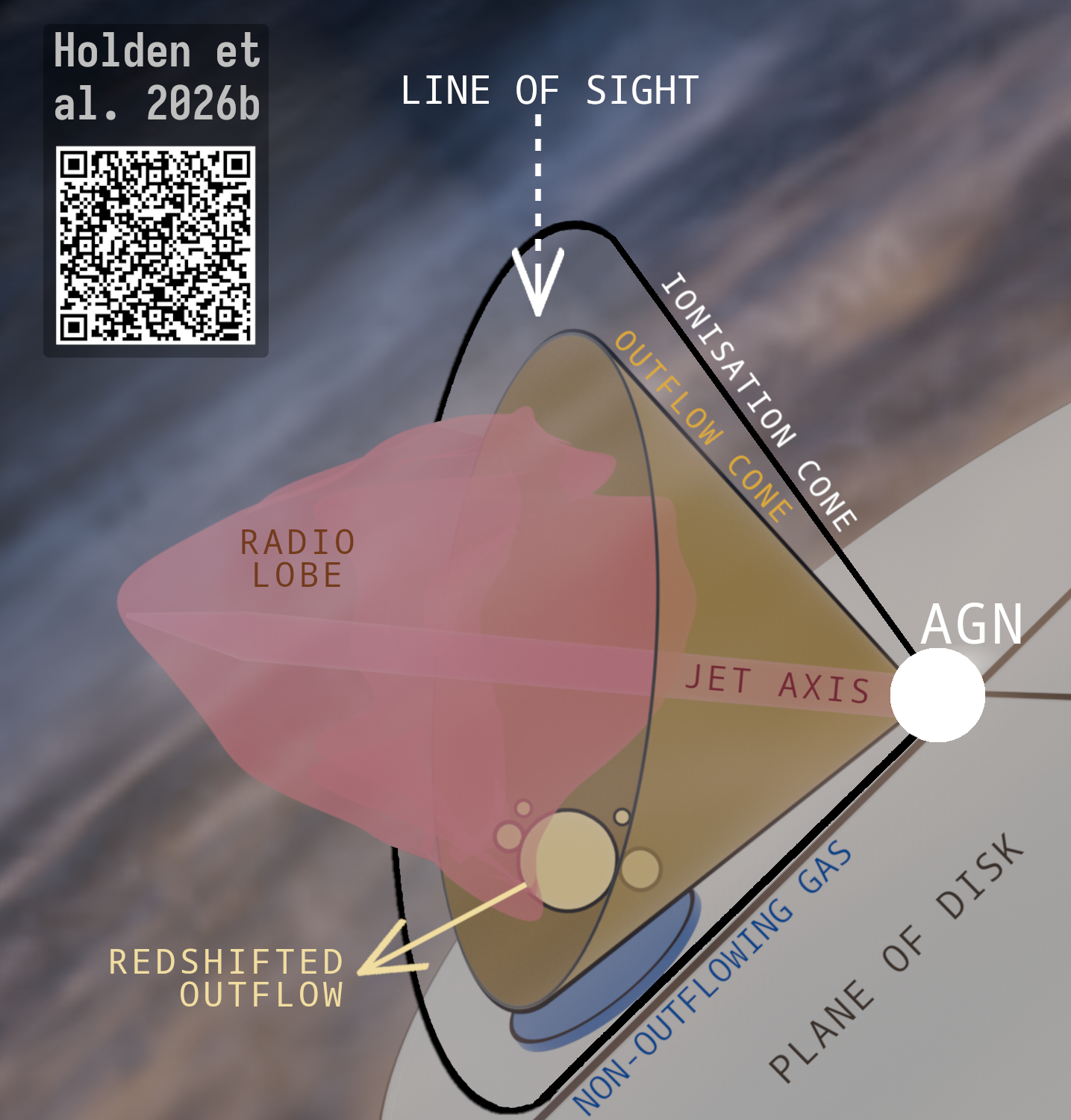
Image credit: Holden et al. 2026b.