SCIENCE BLOG - Paper: Electron densities from [S II] lines significantly overestimate the impact of ionised AGN outflows
Luke Holden - 19th Nov 2025
The first paper of post-doctoral position at Hertfordshire has been accepted for publication in MNRAS, and can be found here.
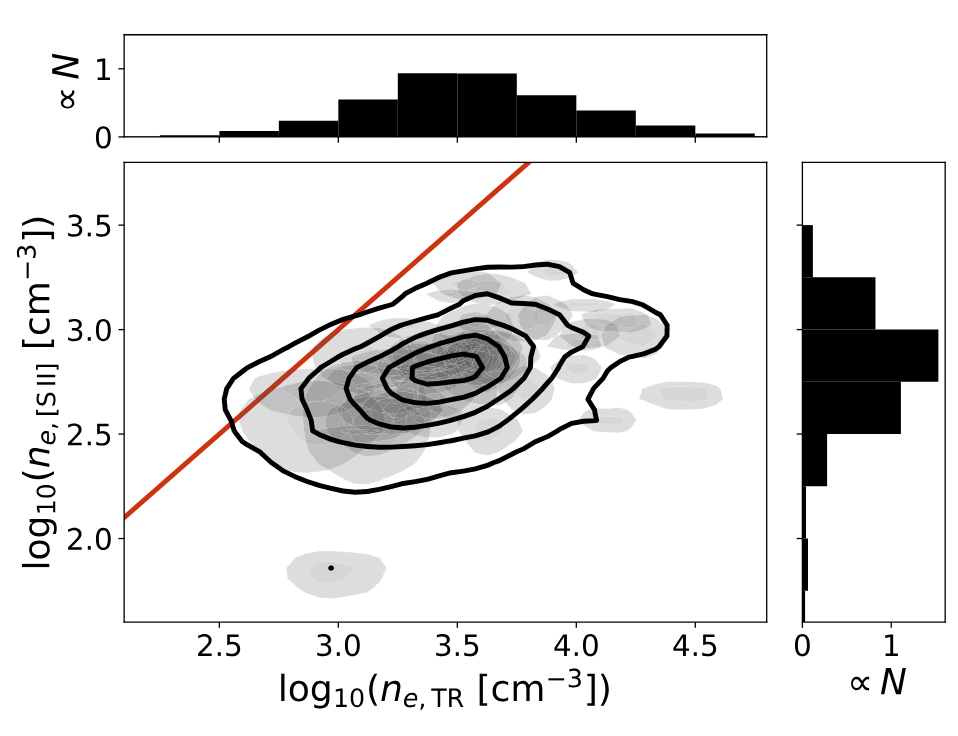
This work compares electron-density measurements made for the outflowing ionised gas in the 48 type-2 quasars that comprise the QSOFEED sample using two methods: the commonly-used `traditional' [S II](6717/6731) emission-line flux ratio, and the `transauroral line' technique first introduced by Holt et al. 2011.. Previous work — including my own papers — have argued that the transauroral lines provide more accurate values than the [S II] method, since the former is sensitive to a wider range of electron densities. Here, we directly demonstrate that this is indeed the case: the [S II] lines produce electron-density values that are 0.75 dex (orders of magnitude) lower than those produced by the transauroral line method (see Figure 1 of this page). Since mass outflow rates and kinetic powers are inversely proportional to electron density, this implies that previous studies that used the [S II](6717/6731) may have significantly overestimated the impact of outflows on their host galaxies. To account for this, we provide a correction factor for use with the [S II] technique, which will prove invaluable for future studies (particularly those performed using spectroscopic survey data) that do not clearly detect the fainter transauroral lines.